

Python isn’t just popular in the AI industry-it’s the backbone of nearly every major AI breakthrough over the last decade. From self-driving cars to chatbots that sound human, Python is the hidden engine behind it all. You won’t find a single top AI lab, startup, or tech giant that doesn’t rely on it. But why Python? And how did it become so dominant? Let’s break it down with real examples, not theory.
Why Python? It’s Not About Being the Fastest
Python isn’t the fastest programming language. C++ runs circles around it in raw speed. Java is more rigidly structured. JavaScript dominates the web. So why did AI teams pick Python? Because it lets engineers focus on solving problems instead of fighting syntax.
Imagine you’re building a neural network to detect tumors in MRI scans. You don’t want to spend weeks writing memory allocators or debugging pointer errors. You want to test ideas fast. Python lets you write a working model in hours, not days. That speed to prototype is everything in AI, where experiments fail more often than they succeed.
Google’s TensorFlow, Meta’s PyTorch, and Hugging Face’s transformers-all built in Python. These aren’t side projects. They’re the tools that power billions of AI applications. And they all work because Python makes them accessible.
The Libraries That Changed Everything
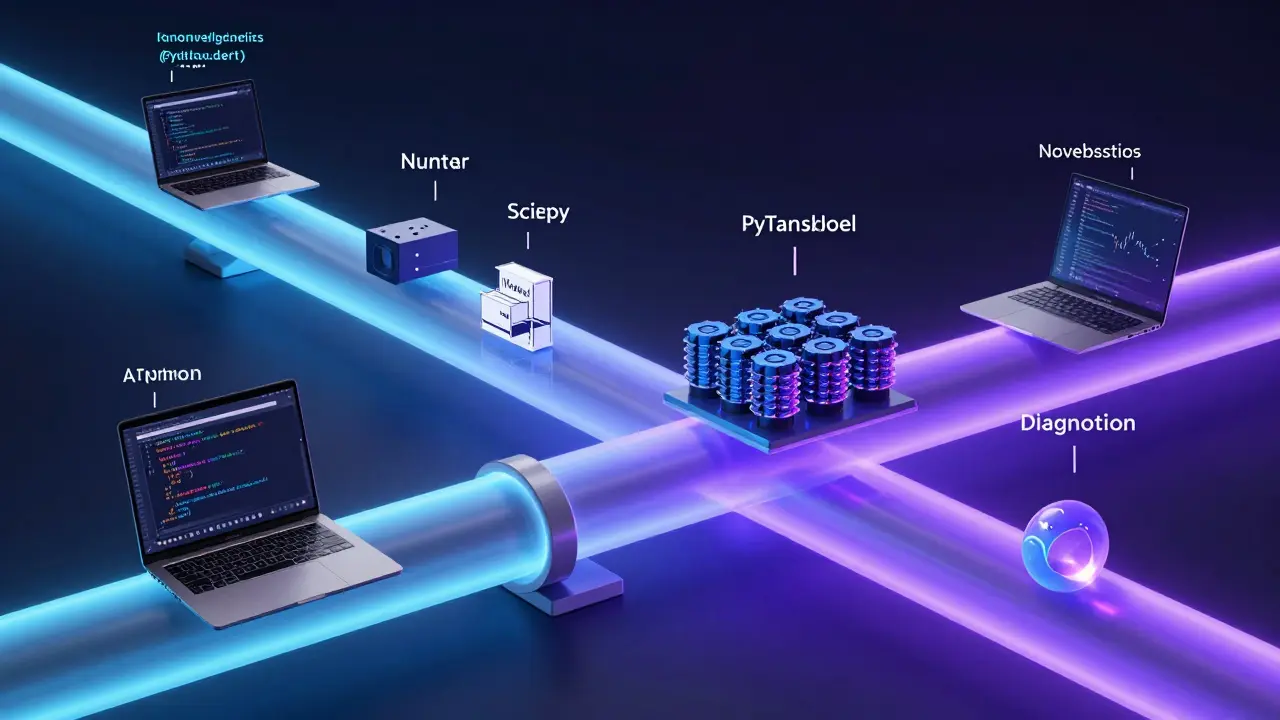
Python didn’t win because it’s elegant. It won because of its ecosystem. Three libraries alone reshaped AI:
- NumPy-handles massive arrays of numbers with ease. Before NumPy, doing matrix math in code was slow and messy. Now, it’s as simple as
matrix.dot(matrix.T). - SciPy-adds scientific functions like optimization, signal processing, and statistics. It’s the math toolkit AI engineers reach for before even touching deep learning.
- Scikit-learn-the go-to for traditional machine learning. Whether you’re predicting customer churn or classifying emails, scikit-learn has a ready-made algorithm with just a few lines of code.
Then came deep learning. TensorFlow and PyTorch took over. PyTorch, in particular, became the favorite for research labs because it feels like writing regular Python. No complex graph definitions. Just build, run, tweak. Researchers at OpenAI, DeepMind, and Stanford all use it daily. And because they use it, their code gets shared openly-creating a snowball effect.
Real-World Impact: What Python AI Can Do Today
Let’s get concrete. Here’s what’s happening right now thanks to Python:
- Netflix uses Python to recommend shows. Their recommendation engine runs on a mix of scikit-learn and custom PyTorch models trained on petabytes of viewing data.
- Waymo (Google’s self-driving unit) relies on Python for sensor fusion-combining lidar, radar, and camera data to understand road conditions. Their entire perception pipeline is Python-based.
- MedAI startups in Melbourne and Boston use Python to analyze X-rays and pathology slides. One company reduced diagnostic errors by 37% using a Python-trained model on publicly available medical datasets.
- Customer service bots at banks and telecoms? Most run on Python-powered NLP models from Hugging Face. No need to build from scratch.
These aren’t experiments. They’re live, production systems handling real users, real money, and real safety-critical decisions.

Who’s Using Python for AI? Not Just Coders
One myth is that AI is only for PhDs with advanced math skills. That’s outdated. Today, data scientists, marketers, doctors, and even high school teachers are using Python for AI.
A teacher in Sydney built a Python script to auto-grade short-answer essays using a pre-trained transformer model. A farmer in Queensland used a Python tool to analyze drone images and predict crop disease before it spread. A small e-commerce store in Adelaide used a Python-based recommendation engine to boost sales by 22% in three months.
The barrier to entry? Lower than ever. You can install Python in minutes. Download a model from Hugging Face. Run it on your laptop. No cloud bills. No team. Just curiosity and a few hours.
The Downside: It’s Not Perfect
Python isn’t flawless. It’s slow for heavy computation. Large models need GPUs. Memory leaks happen. Debugging deep learning pipelines can be a nightmare if you don’t structure your code well.
And yes-some companies still use C++ for performance-critical inference. Tesla’s Autopilot, for example, runs final decision-making in C++ for latency reasons. But even Tesla uses Python for training, testing, and simulation. The workflow is clear: build in Python, optimize later.
The bigger risk? Over-reliance. Some teams treat Python libraries like magic boxes. They copy-paste code from GitHub without understanding how the model works. That leads to biased outputs, failed deployments, and ethical blind spots. Python makes AI easy-but not easy to do right.
The Future: Python Still Leads, But the Game Is Changing
Will Python stay on top? Right now, there’s no real challenger. Rust is faster. Julia is more scientific. But neither has the community, the libraries, or the job market backing them.
What’s changing? Tools are getting smarter. Platforms like Runway ML and Hugging Face Spaces let you deploy AI models without writing code. But underneath? Still Python. Even no-code tools are built on Python frameworks.
And new developments are emerging. PyTorch 2.0 now compiles models into faster code using TorchDynamo. NumPy 2.0 improved memory handling by 40% in benchmarks. These aren’t gimmicks-they’re upgrades that keep Python relevant.
The future of AI isn’t about replacing Python. It’s about making Python better, faster, and easier to use for more people.
What You Should Do Next
If you’re curious about AI and you’ve never coded before: start here.
- Install Python from python.org (it’s free).
- Run
pip install numpy pandas scikit-learnin your terminal. - Try this: load a dataset of house prices, train a model to predict value, and test it. No tutorials needed-just follow along with the scikit-learn docs.
- Once you’re comfortable, move to PyTorch and build a simple image classifier.
You don’t need a degree. You don’t need a job at Google. You just need to start.
Why is Python the most used language in AI?
Python dominates AI because it’s simple to learn, has powerful libraries like TensorFlow and PyTorch, and lets developers prototype fast. It doesn’t require deep systems knowledge, so researchers, engineers, and even non-programmers can build AI tools quickly. The massive open-source community keeps adding tools, making it easier to share and reuse code.
Can you build AI without Python?
Yes, but it’s harder. Languages like R, Julia, or Java can be used for AI, but they lack the ecosystem. Libraries like scikit-learn or Hugging Face’s transformers simply don’t exist in the same way. You’d spend more time building tools than solving problems. For production AI, most teams still use Python-even if they compile parts to C++ for speed.
Is Python good for deep learning?
Absolutely. PyTorch and TensorFlow, the two most popular deep learning frameworks, are Python-first. They let you define neural networks with code that reads like math equations. Training models on GPUs? Python handles it. Debugging gradients? Python makes it visible. Even companies like NVIDIA optimize their drivers for Python workflows.
Do you need to know math to use Python for AI?
Not at first. You can use pre-built models from Hugging Face or scikit-learn without knowing calculus or linear algebra. But to improve models, fix errors, or innovate, you’ll need to understand basics like how gradients work or what overfitting means. Think of it like driving a car-you don’t need to know how the engine works to use it, but fixing a flat tire helps.
Is Python the best choice for beginners in AI?
Yes. Python’s syntax is readable, its error messages are clear, and there are thousands of free tutorials built for beginners. Tools like Google Colab let you run AI code in your browser with zero setup. You can go from zero to training your first model in under an hour. No other language offers that combination of simplicity and power.