
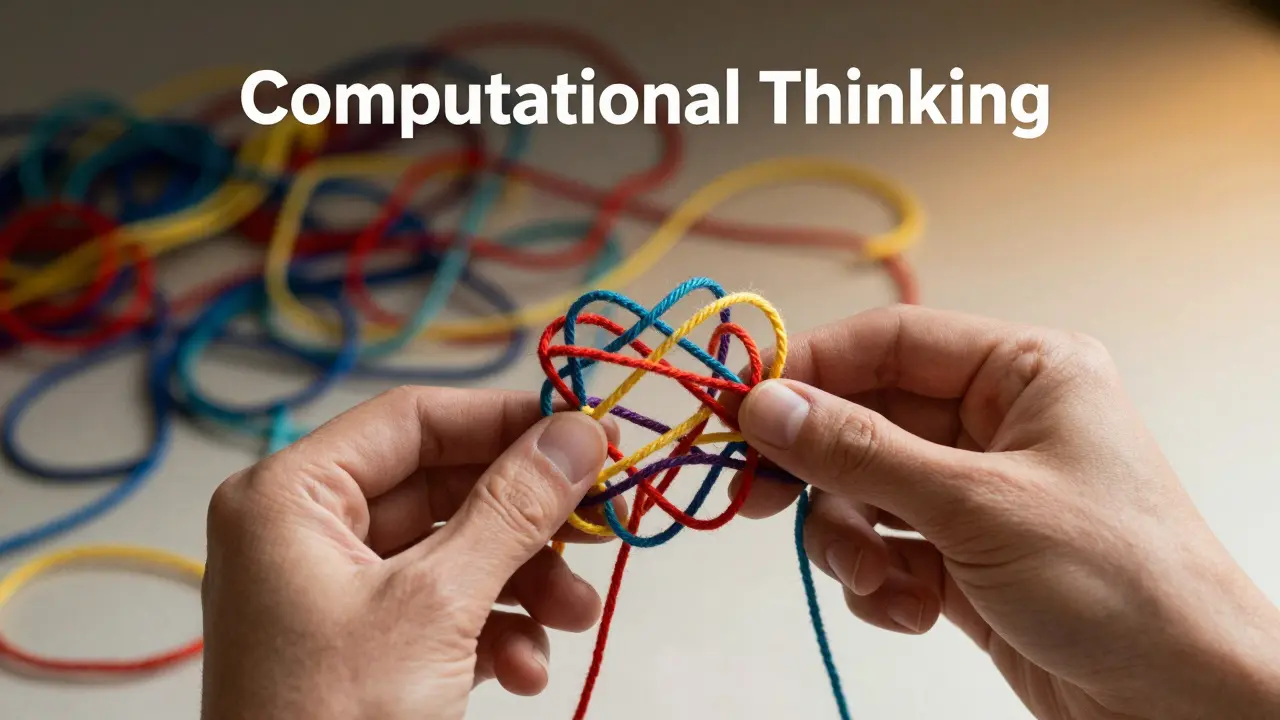
You’ve probably heard the cliché that coding is just about talking to machines. But if you’ve ever spent an hour staring at a line of code that refuses to work, you know it’s actually about talking to yourself. It’s about untangling your own thoughts.
The real magic of coding skills is not in building apps or websites. It’s in how they rewire your brain for problem-solving abilities. When you learn to code, you aren’t just memorizing syntax. You are training your mind to break down chaos into order. This shift changes how you handle everything from a broken sink to a complex business strategy.
The Core Mechanism: Computational Thinking
At the heart of this transformation is Computational Thinking, which is a cognitive process that involves formulating problems so that a solution can be provided by a computer. It sounds technical, but it’s really just a specific way of looking at the world. Instead of seeing a massive, scary problem, you see a series of small, manageable steps.
This mindset relies on three main pillars:
- Decomposition: Breaking a big problem into smaller parts. If you’re planning a wedding, you don’t just “plan a wedding.” You plan the venue, then the food, then the guest list. Coding forces you to do this constantly.
- Pattern Recognition: Noticing similarities between current problems and past ones. Have you seen this error before? Does this situation look like that one?
- Abstraction: Focusing on what matters and ignoring the noise. In code, you ignore the color of the button to focus on what happens when it’s clicked. In life, you ignore the drama to focus on the core issue.
When you practice these daily, they become automatic. You stop reacting emotionally to problems and start analyzing them structurally.
Debugging Teaches Resilience and Logic
Let’s talk about Debugging, the process of finding and fixing errors in computer programs. Most people hate it. They feel stupid when their code doesn’t work. But this frustration is where the growth happens.
Debugging teaches you that failure is data. When your code crashes, it’s not a judgment on your intelligence. It’s a clue. You have to ask: What did I expect to happen? What actually happened? Where is the difference?
This logical deduction applies directly to real life. Imagine your marketing campaign isn’t converting. A non-coder might blame the audience or get frustrated. A coder looks at the funnel. Did the email open? Did they click the link? Did the page load? You isolate variables until you find the break. This systematic approach saves time and reduces stress.
From Ambiguity to Precision
Human language is messy. We say things like “make it pop” or “fix it soon.” Computers are terrible at guessing. They need precision. This gap forces coders to develop extreme clarity in their communication.
If you tell a computer to “sort the list,” it will ask: Sort by what? Ascending or descending? Case-sensitive? This habit of specifying details carries over to your job. You start writing clearer emails. You give more precise instructions to your team. You define success metrics before starting a project. This precision reduces misunderstandings and makes collaboration smoother.

Coding vs. Traditional Education
Schools often teach us to seek the single right answer. There is one correct solution to 2 + 2. But in coding, there are often ten ways to solve one problem. Some are faster, some are easier to read, some use less memory.
This exposure to multiple solutions builds flexibility. You learn to evaluate trade-offs. Is speed more important than readability here? Is security more important than convenience? These are not just tech questions; they are life questions. Learning to weigh pros and cons without seeking a perfect answer makes you a better decision-maker.
| Aspect | Traditional Approach | Coding-Influenced Approach |
|---|---|---|
| Viewing Problems | Often seen as overwhelming obstacles | Seen as systems with inputs and outputs |
| Handling Failure | Personal setback or embarrassment | Data point for iteration |
| Communication | Vague, relies on context | Precise, explicit requirements |
| Solution Strategy | Seeking one right answer | Evaluating trade-offs and alternatives |
Automation and Efficiency Mindset
One of the most powerful habits coders develop is the desire to automate repetitive tasks. If you have to do something twice, you write a script to do it forever. This is the essence of efficiency.
This mindset helps you identify waste in your daily life. Are you manually entering data into spreadsheets every week? That’s a bug in your workflow. You should fix it. By constantly asking, “Can this be automated?” you free up mental energy for creative and strategic work. You stop being a processor of information and start being a creator of value.

Practical Ways to Apply These Skills
You don’t need to be a software engineer to benefit from this. Here is how you can apply coding logic to everyday situations:
- Define the Input and Output: Before starting any task, clearly state what you have (input) and what you want (output). If you’re writing a report, the input is raw data, the output is insights. Keep the goal visible.
- Break It Down: If a task feels too big, you haven’t decomposed it enough. Keep breaking it down until each step takes less than 30 minutes.
- Test Early: Don’t wait until the end to check your work. Build small prototypes. Get feedback early. It’s cheaper to fix a mistake now than later.
- Document Your Process: Write down how you solved a problem. Next time, you’ll recognize the pattern instantly. This is your personal library of solutions.
The Future of Work Requires This Hybrid Skill
We are moving into an era where AI handles routine tasks. The human advantage is no longer in knowing facts or performing calculations. It’s in defining the problem correctly. AI can write code, but it needs a human to tell it what to build and why.
Your ability to think computationally allows you to collaborate with these tools effectively. You understand the logic behind the automation. You can spot when the AI is hallucinating or making a logical error. This makes you indispensable. You are not just a user of technology; you are a director of it.
So, pick up a tutorial. Learn Python. Try JavaScript. Do it not because you want to become a developer, but because you want to upgrade your operating system. Your brain is the most powerful tool you have. Coding is the best manual we have for optimizing it.
Do I need to be good at math to benefit from coding's problem-solving benefits?
No. While advanced algorithms require math, basic coding is more about logic and structure than calculation. Think of it like grammar rather than calculus. You need to follow rules and construct sentences, but you don't need to derive formulas. The problem-solving benefit comes from the logical flow, not numerical complexity.
Which programming language is best for learning problem-solving?
Python is often recommended for beginners because its syntax is clean and readable. It forces you to focus on the logic rather than getting bogged down by punctuation errors. However, any language works. The skill transfer happens regardless of whether you choose JavaScript, C++, or Ruby. Pick one and stick with it long enough to finish a few projects.
How long does it take to see changes in my thinking style?
Most people notice a shift after solving their first significant bug, usually within the first few weeks of consistent practice. However, deep integration into your daily life takes months. Aim for 15-30 minutes of coding practice daily. Consistency matters more than intensity. The neural pathways strengthen with repetition.
Can coding skills help in non-tech careers like marketing or sales?
Absolutely. Marketing relies on data analysis and A/B testing, which are essentially experiments similar to debugging. Sales requires understanding customer journeys, which can be mapped like user flows in an app. The structured thinking helps you optimize processes, communicate clearly, and automate tedious tasks, giving you more time for high-value interactions.
Is computational thinking only useful for digital problems?
Not at all. Computational thinking is a universal framework for handling complexity. It applies to organizing a closet, planning a vacation, or resolving a conflict. Any situation with multiple variables and a desired outcome can benefit from decomposition, pattern recognition, and algorithmic thinking. It is a general-purpose tool for clarity.