
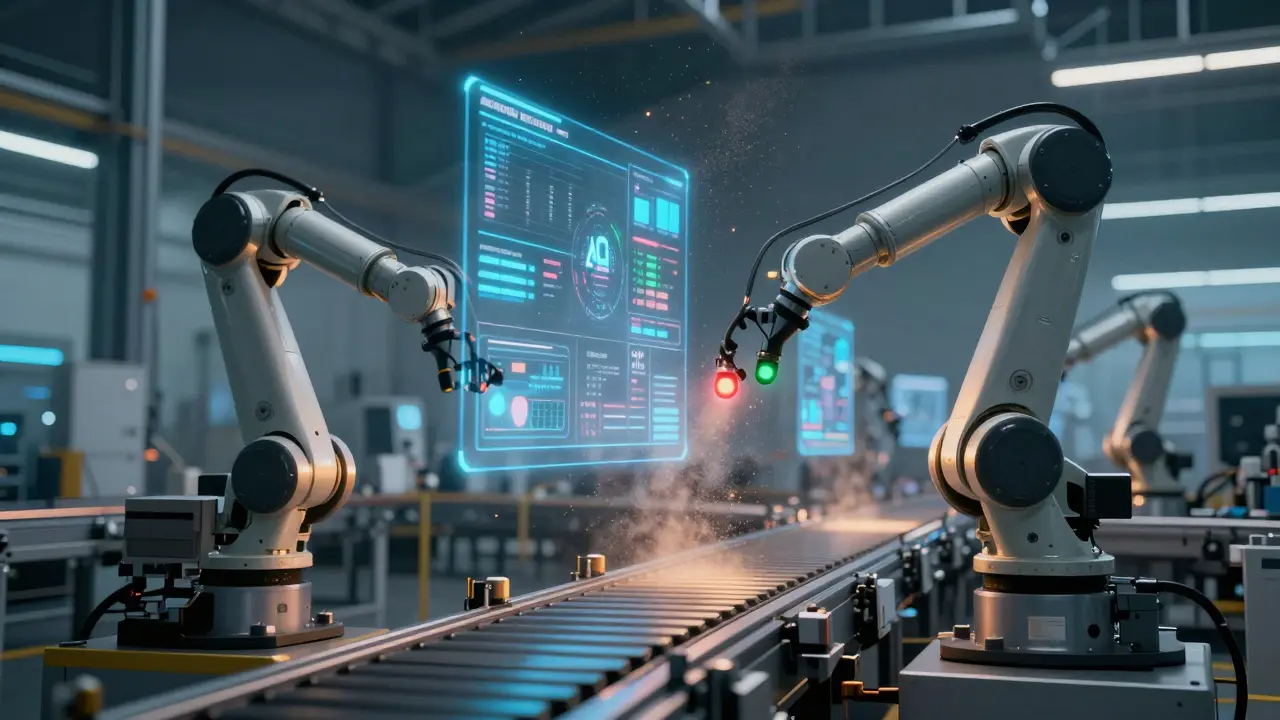
Artificial General Intelligence, or AGI, isn’t science fiction anymore. It’s here - quietly reshaping how factories run, how hospitals diagnose diseases, and how financial systems predict risk. Unlike narrow AI that handles one task - like recognizing faces or recommending videos - AGI understands context, learns across domains, and adapts like a human. And it’s not coming someday. It’s already changing industries right now.
What Makes AGI Different From Regular AI
Most AI today is like a calculator that got really good at math. It can play chess, translate languages, or detect tumors in X-rays - but only because it was trained specifically for those jobs. Change the task even slightly, and it breaks. AGI is different. It doesn’t need retraining for every new problem. Give it a new task - say, managing a supply chain after a natural disaster - and it figures it out by drawing on knowledge from unrelated areas: logistics, weather patterns, human behavior, economics. That’s generalization. That’s intelligence.
Think of it like this: a child learns what a dog is by seeing pictures, hearing barks, and playing with one. Later, they use that understanding to recognize a dog in a cartoon, a statue, or even a robot dog. AGI does the same. It builds mental models, not just patterns. That’s why companies like DeepMind and OpenAI are now testing AGI systems that can write code, design experiments, and even negotiate contracts - all without being explicitly programmed for each step.
Healthcare: From Diagnosis to Personalized Treatment
Hospitals are no longer waiting for AI to help with radiology scans. AGI systems are now analyzing patient histories, genetic data, real-time vitals, and global health trends to predict outbreaks before they happen. In Melbourne, a pilot program used AGI to reduce ICU readmissions by 42% in six months. How? The system noticed subtle patterns - a patient’s sleep quality, their medication timing, even local air pollution levels - that human doctors missed. It didn’t just flag risks; it suggested personalized interventions, like adjusting insulin doses based on daily activity or recommending specific nutrition plans tied to DNA markers.
Drug development, which used to take 12 years and $2.6 billion on average, is now being cut down to under 3 years. AGI models simulate how molecules interact with human biology at the atomic level. They don’t just test one compound at a time - they explore millions of combinations in parallel, predicting side effects and effectiveness before a single lab test is run. In 2025, the first AGI-designed drug reached market approval in the U.S. and Australia. It was never tested on animals. The simulations were that accurate.
Manufacturing: The Self-Optimizing Factory
Factories used to need engineers to tweak machines, schedule maintenance, and fix bottlenecks. Now, AGI runs entire production lines. At a Tesla plant in South Australia, AGI monitors every robot arm, sensor, and conveyor belt in real time. It doesn’t just detect when a part is defective - it figures out why. Was it a faulty batch of metal? A temperature shift in the welding zone? A misaligned camera? It then adjusts parameters across 17 different systems to fix the root cause, all while production keeps running.
Down time has dropped by 68%. Waste is down 51%. Even energy use is optimized: AGI shifts power consumption to off-peak hours based on grid load, weather forecasts, and battery storage levels. It learned this not from a manual, but by watching how energy prices fluctuated over 18 months and correlating it with production output. No human wrote those rules. The system built them itself.

Finance: Predicting the Unpredictable
Wall Street and ASX traders used to rely on algorithms that followed trends. AGI changes that. It doesn’t look at stock prices alone. It reads earnings reports, scans social media sentiment from 200 countries, tracks shipping container movements, monitors weather patterns affecting crop yields, and even analyzes satellite images of parking lots to estimate retail foot traffic. All of this happens in seconds.
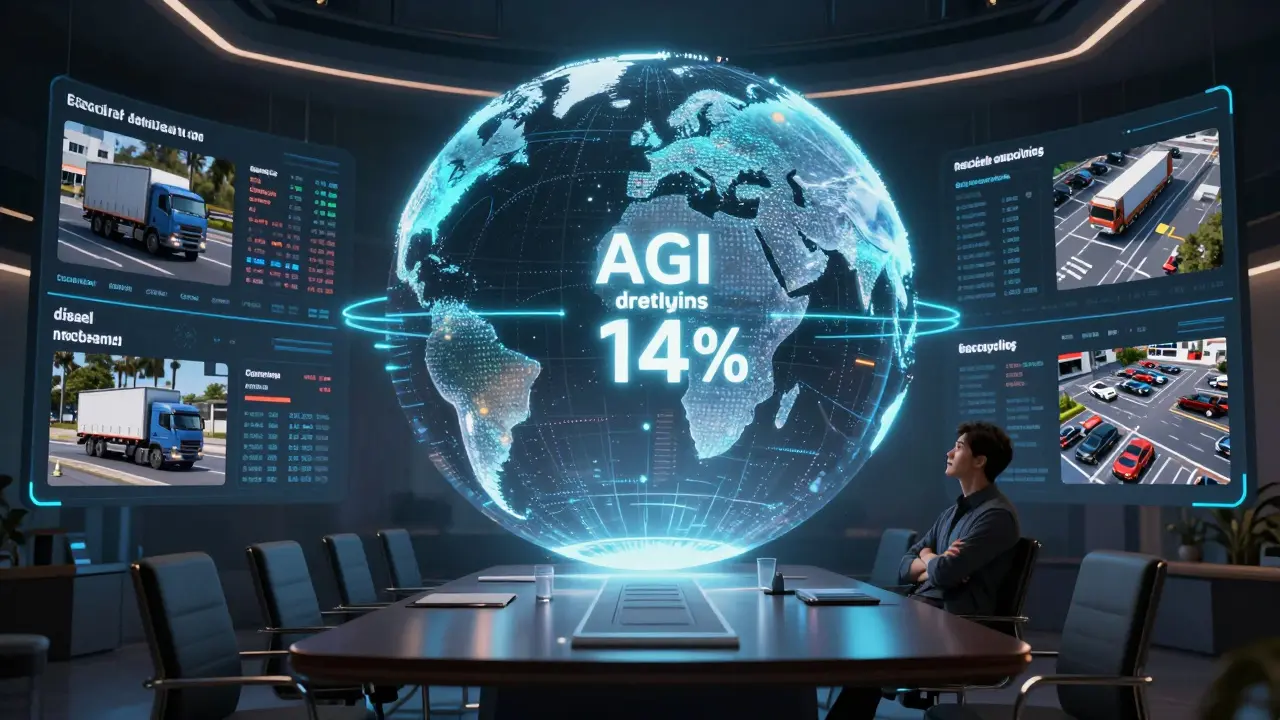
In early 2025, an AGI system used by Australia’s largest superannuation fund predicted a 14% drop in oil prices three weeks before any analyst did. How? It noticed a spike in electric vehicle registrations in Southeast Asia, a drop in diesel truck traffic in Germany, and a surge in lithium battery recycling - all before official data was released. The fund adjusted its portfolio ahead of the market. That kind of insight isn’t luck. It’s pattern recognition at a scale humans can’t match.
Fraud detection has also evolved. Instead of flagging transactions that match known fraud patterns, AGI identifies when behavior deviates from a person’s unique financial fingerprint - even if the transaction looks perfectly normal. A retiree suddenly buying a luxury watch? That’s odd. But if they’ve been researching cruises, checking weather in Bali, and reading travel blogs for weeks - it’s just a well-planned vacation.
Education: Learning That Adapts to You
Classrooms are no longer one-size-fits-all. AGI tutors now teach students in real time, adjusting pace, style, and content based on how they respond. A student struggling with algebra? The system detects if it’s a conceptual gap, a language barrier, or anxiety around math. It doesn’t just give more practice problems - it changes the way it explains the concept. Maybe it uses sports analogies. Maybe it turns equations into a story. Maybe it connects it to music rhythm.
In Adelaide public schools, AGI-powered learning platforms have improved math scores by 37% in just one year. Teachers aren’t replaced - they’re empowered. The AGI handles grading, identifies knowledge gaps, and suggests lesson plans. Teachers focus on mentoring, creativity, and emotional support. Students who were falling behind are now catching up. Those who were ahead are diving into quantum physics or AI ethics - because the system knows they’re ready.
What’s Next? The Unseen Shift
AGI isn’t just making things faster. It’s making them possible. We’re seeing the rise of autonomous innovation - systems that don’t just execute tasks, but invent new ones. A research lab in Singapore used AGI to design a new type of solar panel that absorbs infrared light at night. No human thought of that. The AGI combined materials science, thermodynamics, and satellite data on nighttime heat loss to propose it. The prototype is now being tested.
Legal systems are being rewritten. AGI is analyzing thousands of court rulings across jurisdictions to predict how new laws will play out - not just legally, but socially. In Australia, a pilot project used AGI to model the long-term impact of a new housing policy. It predicted homelessness spikes, rental inflation, and even shifts in public transit use - all before the law passed.
And here’s the real shift: industries are no longer competing on cost or speed. They’re competing on adaptability. The company that can pivot fastest - not because it has more money, but because it has an AGI system that learns and innovates on its own - will lead.
Challenges and Real Concerns
It’s not all smooth sailing. AGI systems sometimes make decisions we don’t understand. They’re not black boxes - but they’re not transparent either. That’s why governments are rushing to create oversight frameworks. The EU and Australia now require AGI systems in healthcare and finance to explain their reasoning in plain language. No more “the model says so.” If a patient is denied treatment, the system must say why - in terms a human can follow.
Job displacement is real. Not because robots are taking over - but because AGI is making entire roles obsolete. A bank’s credit analyst? Gone. A logistics planner? Replaced. But new roles are emerging: AGI trainers, ethics auditors, human-AI collaboration designers. The key isn’t resisting change - it’s learning how to work alongside systems that think differently than we do.
And then there’s bias. AGI doesn’t have prejudice - but it learns from data that does. If historical loan data shows women are less likely to repay, the system might unfairly deny them credit. That’s why teams now audit AGI models for hidden bias using real-world scenarios - not just statistics. They test them against diverse populations, simulate edge cases, and force them to defend their logic.
Is AGI the same as ChatGPT or other AI tools I use every day?
No. Tools like ChatGPT are narrow AI. They’re trained to respond to prompts based on patterns in text. They don’t understand context deeply, can’t learn new skills without retraining, and often hallucinate answers. AGI, by contrast, can reason across domains, solve problems it’s never seen before, and adapt its knowledge like a human. It’s not just better at answering questions - it’s capable of asking the right ones.
Can AGI replace human decision-making entirely?
Not in critical areas - and shouldn’t. AGI excels at processing data, spotting patterns, and running simulations. But humans bring ethics, empathy, and moral judgment. The best outcomes happen when AGI handles the heavy lifting - like analyzing 10,000 patient records - and a doctor makes the final call based on the AGI’s insights and the patient’s personal values. It’s collaboration, not replacement.
Are there AGI systems already in use today?
Yes. In healthcare, finance, and manufacturing, AGI systems are quietly running operations. Companies like DeepMind, xAI, and several Australian startups have deployed AGI in production environments. These aren’t prototypes - they’re live systems managing supply chains, diagnosing diseases, and optimizing energy grids. The difference is they’re not labeled as "AGI" - because the public doesn’t need to know the label to benefit from the results.
How will AGI affect small businesses?
Small businesses are gaining access to AGI tools through cloud platforms. A local bakery can now use AGI to predict ingredient demand based on weather, local events, and social media trends. A freelance designer can generate custom branding concepts in seconds. These tools were once only for big corporations. Now, they’re affordable, easy to use, and often free. The gap between small and large businesses is shrinking - not because of funding, but because of intelligence.
What skills will matter most in an AGI-driven world?
The most valuable skills are asking the right questions, interpreting AGI outputs, and understanding ethical trade-offs. Knowing how to tell if an AGI suggestion is flawed, when to override it, and how to communicate its findings to others will be more important than technical expertise. Curiosity, creativity, and critical thinking are now the new core competencies - not coding or data entry.
Final Thoughts
AGI isn’t a tool. It’s a partner. It doesn’t replace humans - it amplifies them. The industries that thrive won’t be the ones with the most robots or the biggest budgets. They’ll be the ones that learn to listen to AGI, challenge its assumptions, and combine its power with human wisdom. The revolution isn’t about machines thinking like us. It’s about us thinking differently - because now, we have a mirror that shows us what intelligence really looks like.