
Stop writing code that looks like it was assembled by a committee of confused interns. If you’ve been using PHP is a popular server-side scripting language designed for web development but also used as a general-purpose programming language for more than a few years, you probably know the pain of legacy spaghetti code. But here’s the good news: becoming a PHP guru doesn’t require memorizing the entire RFC archive or rewriting your framework from scratch. It requires mastering a handful of simple, high-impact tricks that make your code cleaner, faster, and significantly less painful to debug.
We’re not talking about obscure hacks that break in the next minor update. We’re talking about modern features introduced in PHP 8.1, 8.2, and 8.3 that most developers still ignore because they haven’t updated their mental models since 2015. By applying these specific techniques, you’ll write fewer lines of code, reduce runtime errors, and produce software that actually scales. Let’s get straight into the code patterns that separate the juniors from the pros.
The Power of Named Arguments and Constructor Property Promotion
One of the biggest reasons PHP code becomes unreadable is function calls with five or six arguments. You know the type: `createUser($id, $name, $email, $password, $role, $status)`. When you call this function, you have to remember the exact order of parameters. If you swap `$email` and `$password`, you don’t just get a bug; you get a security vulnerability waiting to happen.
This is where Named Arguments are a feature allowing function arguments to be passed by name rather than position, improving readability and reducing errors come in. Introduced in PHP 8.0, this feature lets you specify which parameter you are passing. Suddenly, the order doesn’t matter. You can skip optional parameters entirely without filling them with `null`. It makes your code self-documenting. Instead of guessing what the third argument is, you see `email: $userEmail`. It’s obvious. It’s safe. And it saves you from scrolling up to the function definition every time you want to use it.
Combine this with Constructor Property Promotion are a shorthand syntax in PHP classes that allows declaring and initializing properties directly within the constructor signature. Before PHP 8.0, creating a class meant writing a property, then typing it again in the constructor, then assigning it. That’s three lines of boilerplate for one variable. With promotion, you do it in one line. This isn’t just about saving keystrokes; it’s about reducing cognitive load. Less boilerplate means fewer places for typos to hide. It forces you to think about the data structure itself, not the mechanics of assigning variables.
Embrace Match Expressions Over Switch Statements
If you still use `switch` statements, you are voluntarily making your life harder. The `switch` statement is old, clunky, and prone to bugs because it uses loose comparison (`==`). This means `1` matches `'1'`, and `true` matches `1`. These implicit type conversions are the root cause of countless subtle bugs in enterprise applications.
Enter the Match Expression is a strict comparison control structure in PHP that returns a value based on pattern matching, eliminating the need for break statements. Unlike `switch`, `match` uses strict comparison (`===`). It does not allow fall-through cases unless you explicitly group them. Most importantly, it is an expression, meaning it returns a value. You can assign the result of a `match` block directly to a variable. No more temporary variables. No more `break` statements to forget. It’s concise, type-safe, and impossible to misuse if you understand basic logic. Replace every `switch` in your codebase today. Your future self will thank you when you’re debugging a production issue at 2 AM.
Null Safe Operator: Stop Checking for Null Manually
Have you ever written code like this?
$city = null;
if ($user !== null) {
    $address = $user->getAddress();
    if ($address !== null) {
        $city = $address->getCity();
    }
}
It’s ugly. It’s verbose. And it’s error-prone. Every time you add a new level of nesting, you increase the chance of forgetting a check. This is known as the "pyramid of doom." In modern PHP, you have the Null Safe Operator is the ->? operator that safely accesses properties or methods on objects, returning null instead of throwing an error if the object is null.
With the null safe operator (`->?`), you can flatten that entire pyramid into a single line:
$city = $user?->getAddress()?->getCity();If `$user` is null, the expression stops immediately and returns null. If `getAddress()` returns null, it stops there. No exceptions. No fatal errors. Just clean, predictable behavior. This trick alone can cut hundreds of lines of defensive code from your project. It encourages a functional style where you describe the path to the data you want, rather than manually verifying each step of the journey.

Read-Only Classes and Properties for Immutability
In large applications, state mutation is the enemy. Objects change unexpectedly, and you spend hours tracking down which part of the code modified a property. To combat this, PHP 8.1 introduced Read-Only Properties are properties that can only be assigned once during object construction, preventing accidental modification later in the application lifecycle, and PHP 8.2 took it further with Read-Only Classes are classes where all properties are implicitly read-only, ensuring complete immutability after instantiation.
By marking a class as `readonly`, you guarantee that no property can be changed after the object is created. This might seem restrictive, but it’s incredibly powerful for Data Transfer Objects (DTOs), configuration objects, and domain entities. It eliminates an entire class of bugs related to unexpected state changes. When you pass a readonly object to a function, you know with absolute certainty that the function cannot alter its internal state. This makes your code easier to reason about, test, and parallelize. It’s a small keyword that enforces discipline across your entire team.
Type Declarations: Strict Types Are Not Optional
You cannot be a PHP guru without enforcing strict types. While PHP has always been dynamically typed, modern PHP allows you to declare types for function parameters, return values, and class properties. This is non-negotiable for professional code. Using Strict Typing is a mode in PHP that prevents automatic type conversion, ensuring variables match their declared types exactly catches errors at development time rather than runtime. If a function expects an integer and receives a string, strict typing throws a TypeError immediately. This fails fast, giving you clear feedback instead of silent corruption of data downstream.
Always add `declare(strict_types=1);` at the top of your files. Combine this with union types and intersection types introduced in recent versions to express complex constraints clearly. For example, a function can accept either a `string` or `int` for an ID. Without type declarations, you’re flying blind. With them, your IDE provides accurate autocomplete, and your static analysis tools can catch mismatches before you even run the code.
Performance Matters: JIT and OpCache
Writing clean code is important, but writing slow code is unacceptable. Many developers assume PHP is inherently slow because of its reputation from a decade ago. That reputation is outdated. Modern PHP, especially with the Just-In-Time (JIT) Compiler is a component in PHP 8+ that compiles bytecode to machine code at runtime, improving performance for CPU-intensive tasks, performs remarkably well. However, JIT is not a silver bullet. It shines in mathematical computations and tight loops, not in typical web request handling.
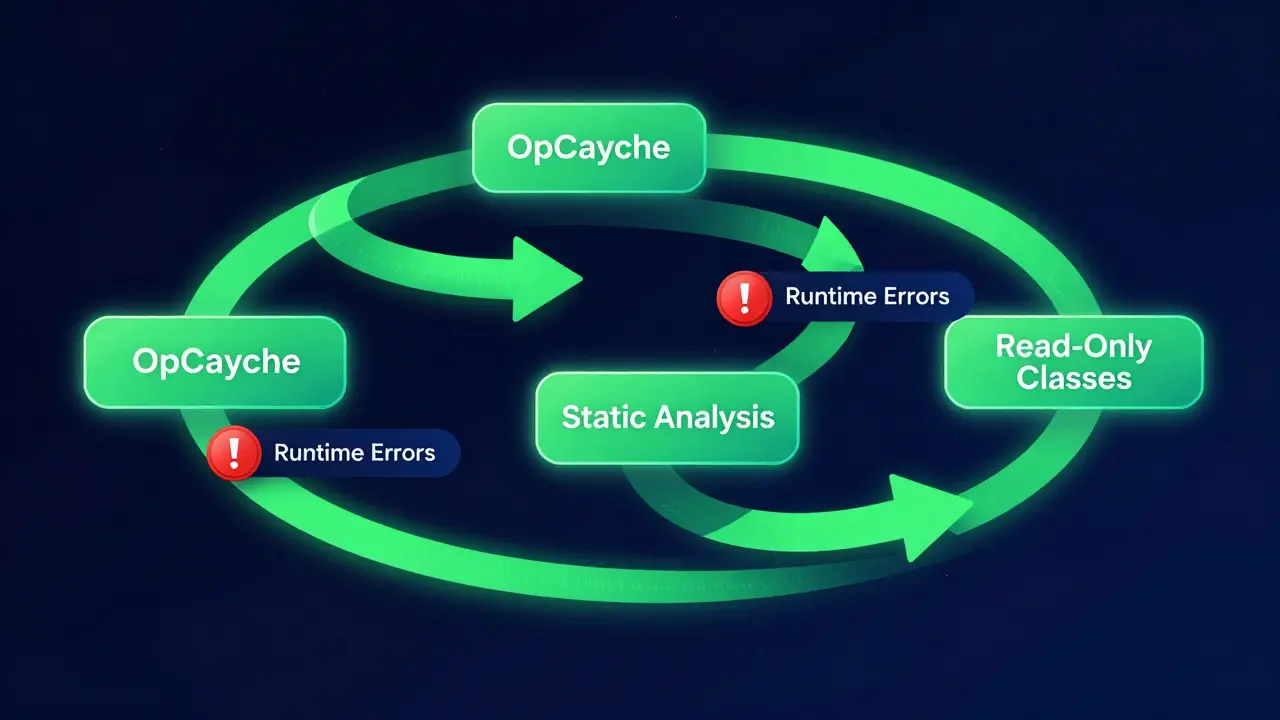
The real performance gain comes from proper configuration of OpCache is a PHP extension that caches precompiled script bytecode in shared memory, eliminating the need for PHP to load and parse scripts on every request. Ensure OpCache is enabled and tuned correctly on your server. Disable file cache validation in production to avoid unnecessary disk I/O. These settings alone can double the throughput of your application. As a guru, you don’t just write code; you understand how it executes. Knowing when to use JIT and how to configure OpCache separates you from the crowd.
| Feature | Legacy Approach | Modern Approach | Benefit |
|---|---|---|---|
| Function Calls | Positional arguments | Named arguments | Self-documenting, order-independent |
| Control Flow | Switch statements | Match expressions | Strict comparison, no fall-through |
| Null Handling | Nested if-statements | Null safe operator (->?) | Concise, no pyramid of doom |
| Object State | Mutable properties | Read-only classes | Immutability, fewer side effects |
| Class Setup | Manual property assignment | Constructor property promotion | Less boilerplate, clearer intent |
Error Handling: Exceptions Over Errors
Old-school PHP relied on error codes and global error handlers. This approach is fragile and inconsistent. Modern PHP gurus use Exceptions are objects representing exceptional conditions that disrupt normal program flow, allowing structured error handling exclusively. Create custom exception classes for your domain logic. Throw them when something goes wrong. Catch them where you can handle them. Never swallow exceptions silently. Use try-catch blocks sparingly, only around code that might fail externally, like database queries or API calls. For internal logic, let exceptions bubble up. This ensures that failures are visible and handled appropriately, rather than hidden behind boolean return values that are easily ignored.
Static Analysis: Catch Bugs Before They Run
You cannot rely on tests alone to find all bugs. Tests cover paths you thought of; static analysis covers paths you didn’t. Tools like PHPStan is a static analysis tool for PHP that detects bugs without running the code, focusing on type safety and code quality or Psalm is another static analysis tool for PHP that checks for type errors and logical inconsistencies in codebases are essential. Integrate them into your CI/CD pipeline. Configure them to fail builds on any error. This forces you to write correct code from the start. It’s annoying at first, but it pays off massively in reduced production incidents. A guru knows that prevention is cheaper than cure.
Conclusion: Consistency Is Key
Becoming a PHP guru isn’t about knowing every obscure function. It’s about consistently applying modern, safe, and efficient practices. Use named arguments. Prefer match over switch. Leverage null safety. Enforce immutability. Enable strict types. Optimize with OpCache. Analyze with static tools. These tricks are simple individually, but together they transform your codebase from a liability into an asset. Start applying them today. Your code will be cleaner, faster, and easier to maintain. And that’s what really matters.
What is the biggest benefit of using named arguments in PHP?
The biggest benefit is improved readability and reduced errors. Named arguments allow you to specify parameter names, making function calls self-documenting and independent of argument order. This prevents mistakes when swapping parameters and makes skipping optional arguments easier.
How does the null safe operator differ from the null coalescing operator?
The null safe operator (?->) is used to access properties or methods on objects, returning null if the object is null. The null coalescing operator (??) is used to provide a default value if a variable is null or undefined. They serve different purposes: one for object navigation, the other for value fallback.
Should I use JIT compilation for my web application?
Generally, no. JIT compilation in PHP is most effective for CPU-intensive tasks like mathematical calculations or image processing. For typical web applications that are I/O bound, JIT offers minimal benefit and may even introduce overhead. Focus on optimizing OpCache and database queries instead.
Why are read-only classes important in modern PHP?
Read-only classes ensure immutability, meaning object properties cannot be changed after creation. This prevents unexpected side effects, makes code easier to reason about, and reduces bugs related to state mutation. It’s particularly useful for DTOs, configuration objects, and domain entities.
What is the difference between match and switch in PHP?
Match uses strict comparison (===) while switch uses loose comparison (==). Match is an expression that returns a value, whereas switch is a statement. Match does not allow fall-through cases unless explicitly grouped, reducing the risk of bugs. It’s more concise and type-safe.
Is strict typing mandatory in PHP?
No, strict typing is not mandatory by default, but it is highly recommended for professional development. Adding declare(strict_types=1); to your files enforces strict type checking, catching type mismatches early and preventing subtle bugs caused by implicit type conversion.
How can I improve PHP performance without changing code?
Enable and tune OpCache. Ensure opcache.enable_cli is set appropriately, disable file cache validation in production (opcache.validate_timestamps=0), and allocate sufficient memory (opcache.memory_consumption). These configurations significantly reduce parsing overhead and improve response times.
What is constructor property promotion?
Constructor property promotion is a PHP 8.0 feature that allows you to declare and initialize class properties directly in the constructor signature. It reduces boilerplate code by combining property declaration, type hinting, and assignment into a single line.