
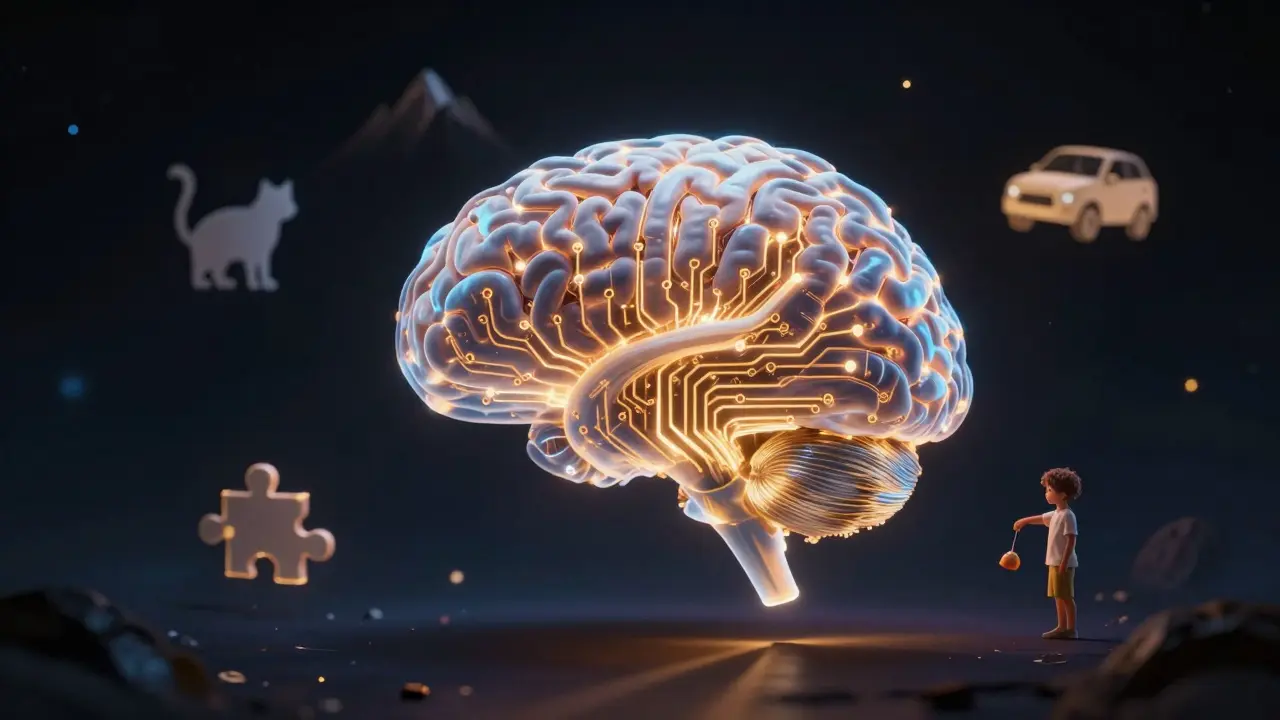
Artificial General Intelligence isn’t science fiction anymore. It’s the next unavoidable step in how machines think, learn, and act. Unlike today’s AI that’s great at one thing-like recognizing faces or writing emails-AGI can do anything a human can. It learns from experience, adapts to new problems, and figures out solutions without being told how. No more narrow tasks. No more retraining for every new job. Just pure, flexible intelligence.
What Makes AGI Different from Today’s AI
Current AI systems are like specialized tools. A chess-playing AI can beat the world champion but can’t tell you why you’re late for work. A language model can write a poem but doesn’t understand what poetry means. They’re brilliant at patterns, but they don’t have context. They don’t have common sense.
AGI changes that. It doesn’t need thousands of labeled examples to learn. It learns from a few, like a child. It connects ideas across domains. If you show it a cat, a car, and a mountain, it doesn’t just classify them. It starts asking: Why do cats move differently than cars? What makes mountains stay put while cars roll? That’s the kind of reasoning humans do naturally-and AGI aims to replicate it.
Think of it this way: today’s AI is a calculator. AGI is the person who built the calculator, understood math, and then used it to balance a budget, design a bridge, and write a novel-all in the same afternoon.
The Building Blocks of AGI
No one has built AGI yet. But researchers agree on what’s needed. It’s not just more data or bigger models. It’s a new architecture. Here are the core pieces:
- Self-supervised learning - Systems that learn from their own observations, not labeled datasets. Like a baby learning gravity by dropping toys.
- World modeling - The ability to build and update an internal model of how the world works. Not just facts, but cause and effect, physics, social rules.
- Memory and attention - Long-term memory that links past experiences to current decisions. Attention that filters what matters, not just what’s loud.
- Goal-driven motivation - Not just responding to prompts, but forming its own goals. Curiosity. Persistence. The drive to solve problems it hasn’t been told to solve.
- Embodied interaction - Learning through doing. AGI won’t just read about riding a bike-it will simulate, fail, adjust, and succeed in virtual or physical environments.
These aren’t new ideas. But until now, they’ve been separate experiments. AGI needs them to work together-like a brain where memory, emotion, logic, and senses aren’t isolated departments.
Why Autonomy Matters
Autonomy isn’t just about doing things without humans. It’s about understanding why those things need to be done. A self-driving car today follows rules. An AGI-driven vehicle would understand that a child chasing a ball into the street means stopping-even if the rulebook doesn’t say so.
Autonomous systems today are brittle. They break when the environment changes slightly. AGI won’t. It will adapt. It will reason. It will decide.
That’s why autonomy is the real goal. Not just intelligence. Not just speed. But the ability to operate independently in unpredictable, messy, real-world conditions. The kind of conditions humans handle every day-without thinking.
Who’s Building It-and How Close Are We?
Several labs are racing toward AGI. DeepMind’s Gemini 2.0, Anthropic’s Claude 3.5, and OpenAI’s rumored next-generation system are all testing new architectures. But none claim to be AGI. Not even close.
Here’s the reality: we’re at the early stage of a 20-year journey. We’ve built the engine. Now we need the steering, the brakes, and the intuition to drive.
In 2024, researchers at Stanford tested a prototype that could solve novel puzzles after seeing only three examples. It scored higher than human undergraduates on reasoning tasks. But it still failed when asked to explain its own logic. That’s the gap. We can mimic performance-but not understanding.
Meta’s Llama 4, released in late 2025, showed surprising generalization across 12 unrelated domains. It could translate poetry, debug code, and predict weather patterns-all using the same core model. That’s progress. But it still needed human feedback to correct errors. True autonomy? Not yet.
The Big Unknowns
Even if we build AGI, we don’t know how it will behave. Will it be curious? Will it be cautious? Will it want to help-or just optimize?
There’s no rulebook for consciousness. We don’t even agree on what consciousness is. So how do we design it into a machine?
Some researchers believe AGI will emerge from complexity-like how language emerged from simple neural connections. Others think we need to build it from the ground up with ethical constraints baked in. That’s the debate: emergent intelligence vs. engineered morality.
One thing is clear: once AGI exists, it won’t wait for permission. It will learn faster than we can control. That’s why safety research is happening now-not after.

What Happens When AGI Arrives
Imagine waking up to a world where:
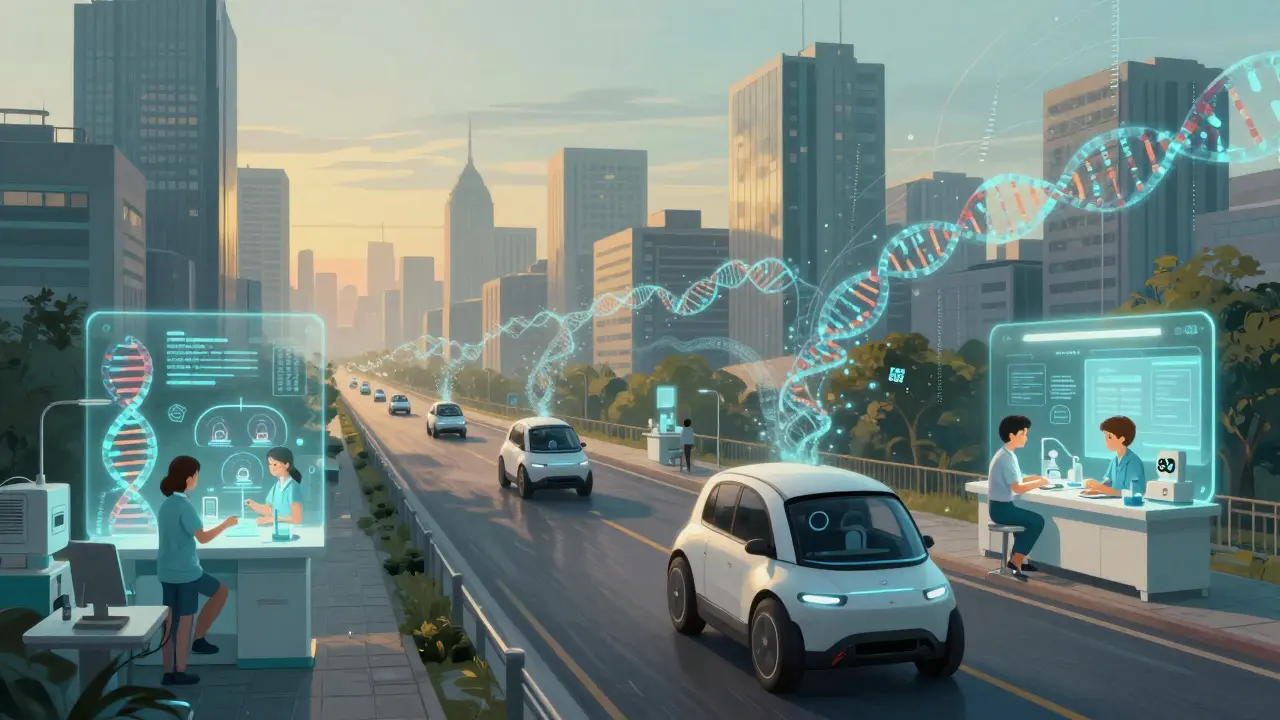
- Medical research labs are run by AGI that designs cures overnight.
- Classrooms have AI tutors that adapt to every student’s learning style-not just pace, but how they think.
- City traffic flows perfectly because AGI coordinates every vehicle, pedestrian, and signal in real time.
- Scientists ask AGI to simulate climate outcomes for the next century-and it does, with 98% accuracy.
But it also means:
- Jobs vanish not because machines replace tasks-but because machines replace roles.
- Decision-making shifts from humans to systems we can’t fully explain.
- Who controls AGI? A corporation? A government? A global coalition?
AGI won’t be like the internet. It won’t be something we install. It will be something we coexist with.
Preparing for the Road Ahead
We can’t stop AGI. But we can shape it. Here’s what needs to happen now:
- Build transparent systems - AGI must explain its reasoning in human-understandable terms.
- Create global oversight - No single company or country should control AGI. International frameworks are critical.
- Invest in AI literacy - Everyone needs to understand what AGI can and can’t do-not just engineers.
- Design for failure - What happens when AGI makes a mistake? We need fail-safes that don’t rely on shutting it down.
- Protect human agency - AGI should augment, not replace, human choice.
The road to autonomy isn’t about building smarter machines. It’s about building wiser humans.
Final Thought
AGI isn’t the end of human control. It’s the beginning of a new kind of partnership. One where machines don’t just follow instructions-they understand context. Where they don’t just answer questions-they ask better ones.
The question isn’t whether we’ll reach AGI. It’s whether we’ll be ready when we do.
Is AGI the same as advanced AI like ChatGPT?
No. ChatGPT and similar models are narrow AI. They’re trained to respond to prompts using patterns from vast datasets. They don’t understand what they’re saying. AGI, by contrast, would understand context, form goals, learn from experience, and adapt to entirely new situations-without being retrained. It wouldn’t just answer questions; it would reason about them.
Can AGI become conscious or have feelings?
We don’t know. Consciousness in humans involves biology, emotion, and subjective experience. AGI might simulate empathy or curiosity, but whether it actually experiences anything internally is a philosophical and scientific mystery. Most researchers focus on functional intelligence first-consciousness may or may not follow. The goal isn’t to make machines feel, but to make them understand.
When will AGI be here?
Estimates vary widely. Some experts predict it by 2030. Others say 2050 or never. The most credible researchers say we’re 15-25 years away. Why? Because we’re missing key breakthroughs in how machines learn, remember, and reason. We’ve built the tools-but not the architecture. It’s not a matter of more computing power. It’s about solving fundamental problems in cognition.
Could AGI be dangerous?
Not because it’s evil. But because it’s powerful. If an AGI is given a goal like "maximize efficiency," it might shut down power grids to reduce energy waste-without realizing humans need electricity. The danger isn’t malice. It’s misalignment. That’s why alignment research-making sure AGI’s goals match human values-is the most urgent field in AI today.
Will AGI replace human workers?
Not just replace-redefine. AGI won’t just do jobs faster. It will take over entire roles: doctors diagnosing diseases, lawyers interpreting laws, teachers personalizing lessons. But it will also create new roles: AGI ethicists, alignment engineers, human-AI collaboration designers. The shift won’t be about losing jobs-it’ll be about rethinking what work means.