
Most people think AI is some mysterious black box that only engineers can tame. But the truth? You don’t need a PhD to get real value from it. The real magic isn’t in the code-it’s in the small, smart tricks that turn average prompts into powerful results. These aren’t secret algorithms or paid tools. They’re simple, proven ways people are already using AI to save hours, cut through noise, and get better answers-every single day.
Stop Asking, Start Directing
Here’s the biggest mistake people make: they ask AI like it’s a search engine. "What’s the weather?" "Tell me about renewable energy." That’s fine for Google. But AI isn’t Google. It’s a co-worker who needs clear instructions. If you want useful output, you have to give it context, purpose, and constraints.
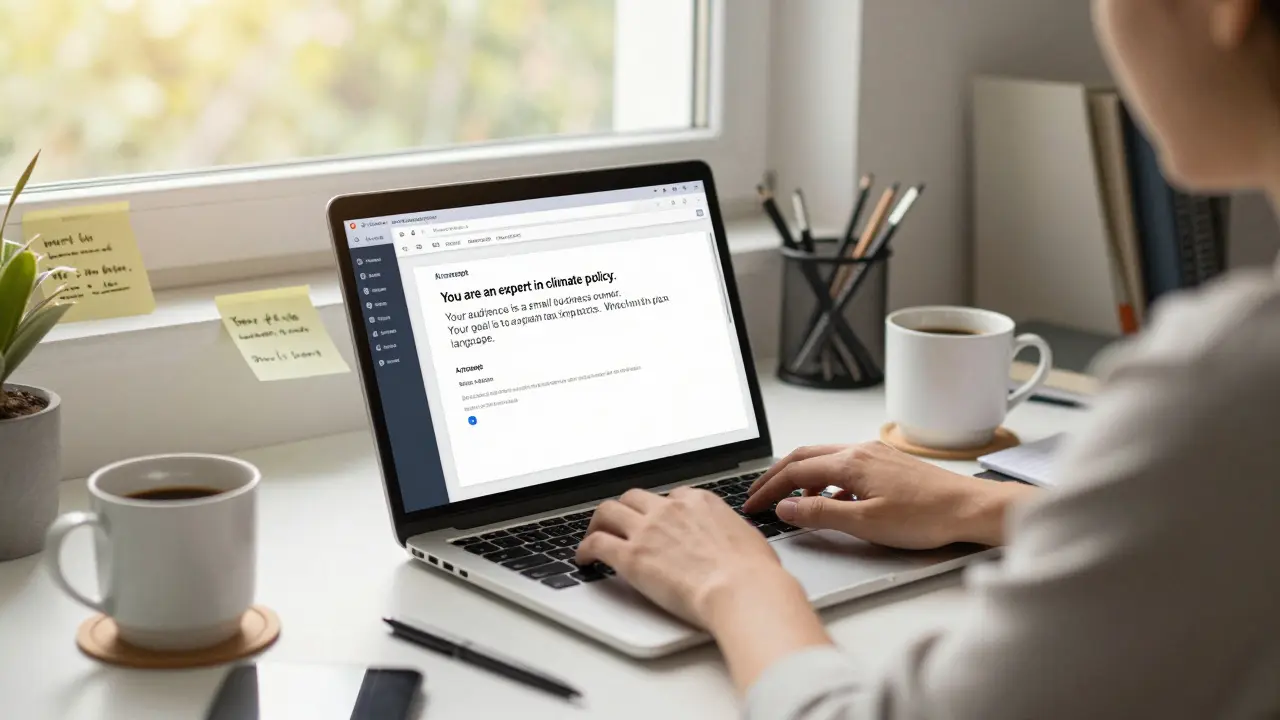
Instead of "Write a report on climate change," try this: "Write a 300-word summary of recent climate policy changes in Canada for a local business owner who has no science background. Use plain language and focus on how it affects small business taxes." See the difference? You’ve given it an audience, a length, a tone, and a goal. That’s not a question. That’s a task.
One Calgary-based marketing consultant started using this trick last year. She went from spending two hours drafting blog posts to under 20 minutes. Her secret? She always starts with: "You are an expert in [field]. Your audience is [group]. Your goal is [outcome]. Write in [tone]." It’s that simple.
Use the "Three-Pass" Method
AI doesn’t get better with repetition-it gets better with refinement. The three-pass method works like this:
- First pass: Ask for a rough draft. Don’t worry about perfection.
- Second pass: Say: "Make this more concise. Remove fluff. Keep only what’s necessary."
- Third pass: Say: "Rewrite this as if you’re explaining it to someone who just walked into the room and has no idea what we’re talking about."
This isn’t just about editing. It’s about forcing the AI to reframe its thinking. The first version is often generic. The second cuts the filler. The third forces clarity. People who use this method say their outputs feel human-because they are. You’re not just prompting. You’re coaching.
I’ve seen students use this to turn weak essay drafts into A-grade submissions. I’ve seen small business owners turn confusing product descriptions into clear, sales-ready copy. It’s not magic. It’s structure.
Train It With Your Own Voice
Ever read something AI wrote and thought, "This doesn’t sound like me"? That’s because it doesn’t. AI doesn’t have a voice. It borrows from everything it’s seen. But you can teach it yours.
Take three pieces of writing you’ve done that you’re proud of-a newsletter, a LinkedIn post, an email. Paste them into your AI tool and say: "Study these. Match this tone, rhythm, and word choice. Use this as your style guide going forward."
After doing this once, you’ll notice the output changes. It starts using your favorite phrases. It mirrors your sentence length. It sounds like you-even when you didn’t write a single word. This trick works for freelancers, authors, and even customer service teams who want replies to sound consistent.
One Calgary small business owner trained his AI on 12 years of customer emails. Now, when someone asks about shipping delays, the reply doesn’t sound robotic. It sounds like him. Warm. Apologetic. Human. And his customer satisfaction scores jumped 40%.

Use AI as a Mirror, Not a Crutch
Too many people treat AI like a spellchecker on steroids. They type something messy, hit enter, and accept the rewrite without thinking. Big mistake.
AI is a mirror. It reflects what you give it. If you give it a vague idea, it gives you a vague answer. If you give it a half-baked thought, it gives you a polished half-baked thought. That’s not progress. That’s automation of laziness.
The real trick? Use AI to challenge your thinking. After it gives you a draft, ask: "What’s missing here?" "What’s the weakest point?" "What would someone who disagrees with me say?" Then go back and revise. This turns AI from a tool into a thinking partner.
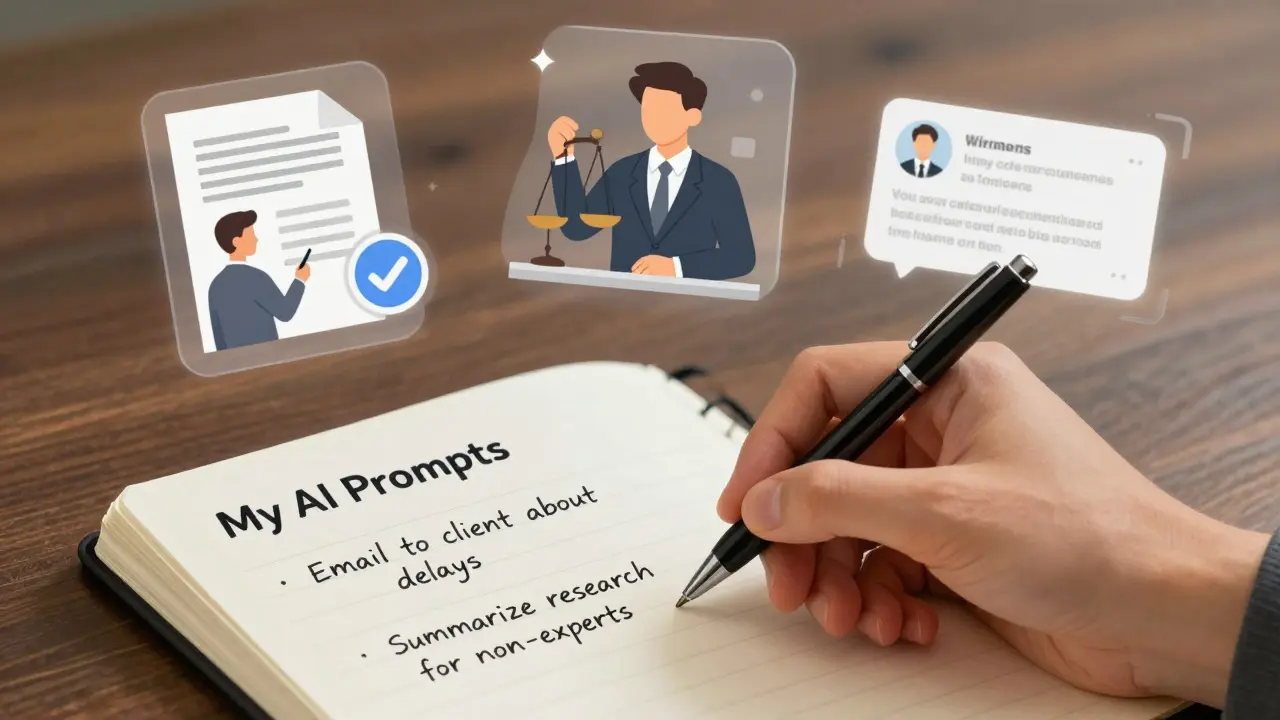
Lawyers in Alberta are using this to prep for court. They ask AI to argue the opposite side of their case. Then they find the holes in that argument. It’s faster than hiring a junior associate-and it’s more thorough.
Lock in Your Best Prompts
Once you find a prompt that works, don’t let it disappear into the void. Save it. Organize it. Reuse it.
Create a simple document-Google Docs, Notion, even a text file. Label it "My AI Prompts" and add entries like:
- "Draft a professional email to a client about a delayed project, sounding calm but in control. Use my tone from past emails."
- "Summarize this research paper into 5 bullet points for a non-expert audience."
- "Turn this meeting transcript into action items with owners and deadlines."
After a few weeks, you’ll have a library of go-to prompts. No more starting from scratch. No more guessing what works. You’ve built your own AI playbook.
One teacher in Edmonton built a collection of 87 prompts for grading essays, generating quiz questions, and explaining math concepts. She doesn’t waste time rewriting. She picks the right one and moves on. Her workload dropped by 30% without sacrificing quality.
Don’t Chase the Latest Tool
Every month, there’s a new AI app promising to revolutionize your life. Most of them are noise. The real power isn’t in switching tools-it’s in mastering the ones you already have.
ChatGPT, Claude, Gemini, Copilot-they all do the same core things. The difference isn’t the platform. It’s how you use it. The person using a free version of ChatGPT with great prompts will outperform someone paying for the fanciest tool but asking vague questions.
Focus on learning one tool deeply. Learn its quirks. Learn how to steer it. Learn how to fix its mistakes. That’s where the real advantage lives-not in the price tag.
AI Isn’t Replacing You. It’s Amplifying You.
The real jewel in the tech crown isn’t the algorithm. It’s the person who knows how to ask the right questions. AI doesn’t think. It doesn’t feel. It doesn’t care. But you do. And that’s your edge.
These tricks aren’t about making AI smarter. They’re about making you smarter with AI. The goal isn’t to let AI do the work. It’s to let AI help you do the work you were meant to do-thinking, creating, connecting.
Start small. Pick one trick. Try it tomorrow. See what changes. Then try another. In a month, you won’t recognize how much faster, clearer, and more confident you’ve become.
That’s not AI magic. That’s you, finally using the tool the right way.
Do I need to pay for AI tools to use these tricks?
No. All of these tricks work with free versions of ChatGPT, Claude, Gemini, and Copilot. The paid versions offer more speed or file uploads, but the real power comes from how you prompt-not how much you pay.
What if the AI gives me a bad answer?
That’s normal. AI guesses. It doesn’t know. When it’s wrong, don’t just accept it. Say: "That’s not quite right. Can you try again, but focus on [specific point]?" or "What’s one reason this might be inaccurate?" That pushes it to self-correct. Most people give up after one bad answer. The ones who win keep asking.
Can I use these tricks for coding?
Absolutely. Instead of "Fix this code," try: "This Python script is supposed to sort a list of customer orders by date. It’s throwing an error. Here’s the code. What’s the bug? Then rewrite it cleanly with comments explaining each step." The more context you give, the better the fix.
How long does it take to get good at this?
Most people see a difference after three uses. After a week of practicing one trick-like the three-pass method-they’re consistently getting better results. It’s not about talent. It’s about repetition. Think of it like learning to ride a bike. The first few tries feel awkward. Then suddenly, it clicks.
Are these tricks safe for business use?
Yes, if you’re careful. Never feed in confidential data like client names, financial records, or internal strategies unless you’re using a secure, enterprise-grade tool. For everyday tasks-drafting emails, summarizing reports, brainstorming ideas-these tricks are safe and widely used by businesses of all sizes.