

Every day, 4.5 billion people interact with AI-without even realizing it. Your phone predicts what you’ll type next. Your email filters out spam. Your favorite streaming service recommends shows you didn’t know you wanted. But if you’re still using AI like a background feature, you’re falling behind. The real edge in 2025 isn’t knowing how AI works. It’s knowing how to use it to do the work you hate, think the thoughts you don’t have time for, and say the things you wish you could say better.
Stop asking AI to write emails. Start asking it to rewrite your life.
Most people treat AI like a fancy autocomplete. They type, "Write me a professional email to my boss," and call it a day. That’s like using a Ferrari to carry groceries. You’ve got a machine that can analyze 10,000 documents in 12 seconds, but you’re using it to fix a typo.
Here’s what actually works: Instead of asking AI to write your email, ask it to reverse-engineer your email. Say this:
- "Here’s my last five emails to my manager. What’s the tone, structure, and unspoken expectation?"
- "Based on these, draft a version that matches their communication style but adds one new insight they haven’t heard yet."
That’s not writing. That’s strategy. Companies like Atlassian and Canva now train their teams to use AI as a mirror-not a scribe. It doesn’t generate content. It reveals patterns you’re blind to. Your tone is too passive. Your subject lines are too vague. Your follow-ups come too late. AI spots this in seconds.
Use AI to build your personal knowledge graph
You’re not drowning in information. You’re drowning in disconnected facts. AI doesn’t just help you remember things-it helps you connect them.
Try this: Every time you read an article, watch a video, or attend a meeting, dump the key takeaways into a single AI-powered note app-like Obsidian with AI plugins or Notion AI. Then ask:
- "What three ideas from the last month connect to my current project?"
- "Which person in my network has written about this before?"
- "What’s the most surprising contradiction in my own notes?"
This isn’t note-taking. It’s thinking with a partner. A 2024 study from MIT found that professionals who used AI to map their own knowledge over 90 days made 40% more creative connections than those who didn’t. They didn’t get smarter. They just stopped forgetting what they already knew.
Automate your decision fatigue, not your work
Decision fatigue kills more productivity than distractions. You spend hours choosing which tool to use, which meeting to skip, which email to answer first. AI can fix that.
Set up a simple rule: Every morning, paste your calendar, inbox, and to-do list into an AI tool and ask:
- "Which three things here will have the biggest impact in the next 72 hours?"
- "Which tasks can be delegated, delayed, or deleted based on my past behavior?"
- "What’s the one thing I’m avoiding that’s costing me time?"
Tools like Motion, Reclaim, and even ChatGPT with custom prompts can do this. You don’t need to automate your entire workflow. Just automate your prioritization. One marketing director in Melbourne cut her weekly planning time from 4 hours to 17 minutes. She didn’t change her workload. She changed how she chose what to do.
Turn AI into your personal reputation engine
People don’t remember what you say. They remember how you make them feel. And AI can help you make people feel seen-without you having to be a social media guru.
Here’s how: Every week, pick one person you admire in your field. Feed AI their last 10 LinkedIn posts or articles. Then ask:
- "What themes do they return to? What problems do they solve? What’s their unspoken belief?"
- "Write a 150-word comment that adds value without repeating them. Make it sound like me, not a bot."
Then post it. No likes, no shares-just one thoughtful comment. Do this for 12 weeks. You’ll start getting replies. Then DMs. Then invites to speak. Not because you’re viral. But because you started showing up with insight, not noise.
This isn’t manipulation. It’s respect. AI helps you listen better. And in a world full of shouting, that’s the rarest skill.
Build your AI feedback loop
Most people use AI once and move on. That’s like buying a gym membership and never showing up. The real trick? Make AI part of your daily feedback cycle.
At the end of each day, ask:
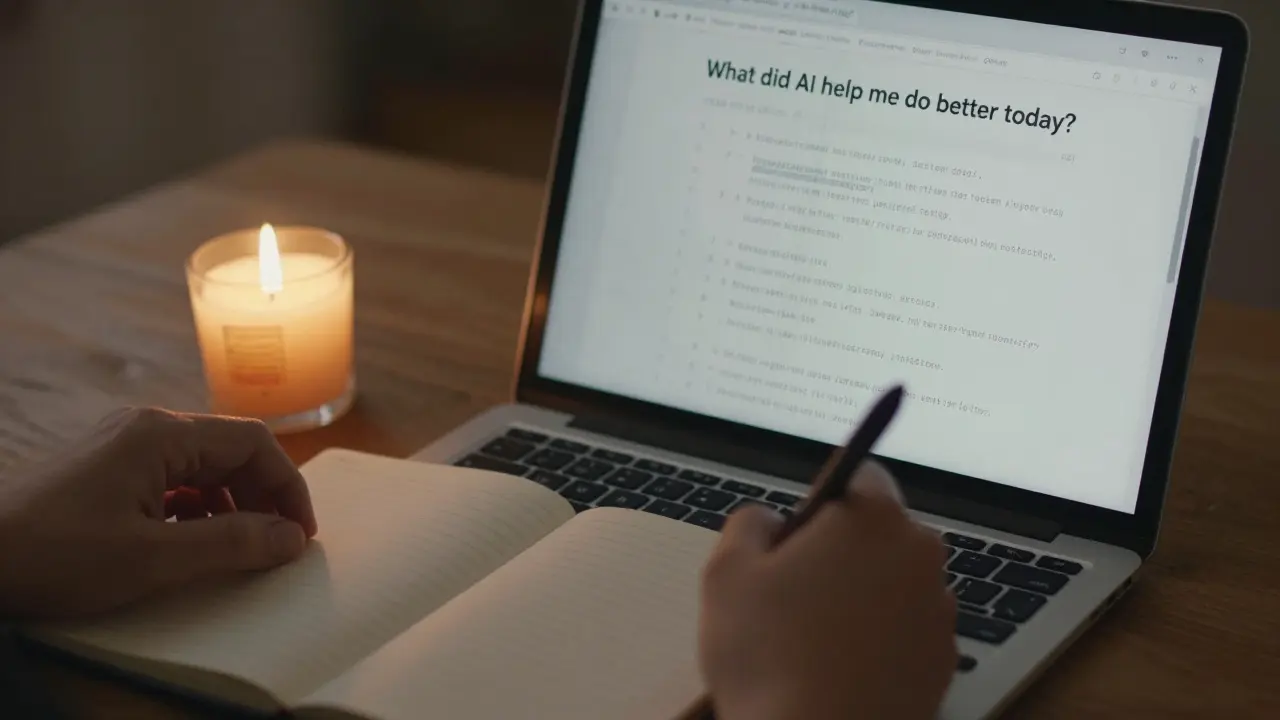
- "What did I do today that AI helped me do better?"
- "What did I do that AI didn’t help with-and why?"
- "What’s one thing I need to stop doing, and what’s one thing I need to start doing tomorrow?"
Write the answers down. Not in a fancy app. Just a notebook. Or a sticky note. Review them every Friday. After 6 weeks, you’ll see patterns. Maybe you’re over-relying on AI for creative work. Maybe you’re using it too late in the process. Maybe you’re not asking the right questions.
Your AI usage isn’t about tools. It’s about habits. And habits compound.

Stop chasing the latest AI tool. Start mastering the basics.
There’s a new AI tool every 3 days. But the ones that actually change your life? They’re the same ones you’ve heard of: ChatGPT, Claude, Gemini, Perplexity, Notion AI.
What separates the people who stand out isn’t the tool. It’s how they use it. The top performers don’t switch tools. They deepen their prompts.
Here’s the cheat code: Every time you use AI, ask it to explain its answer. Not just give you the result. Ask:
- "Why did you choose this structure?"
- "What alternatives did you consider and reject?"
- "How would a skeptical expert respond to this?"
That’s how you learn. That’s how you stop being a user-and become a director. You’re not asking AI to do the work. You’re training it to think like you.
You don’t need to be an AI expert. You just need to be a better asker.
The digital age doesn’t reward the smartest people. It rewards the most intentional ones. You don’t need to know how transformers work. You don’t need to fine-tune models. You just need to know how to ask better questions.
Start tomorrow. Pick one task you hate. Give it to AI. But don’t just ask for a result. Ask for a strategy. Ask for a pattern. Ask for a reflection.
Stand out isn’t about doing more. It’s about doing less-with more clarity. And AI? It’s the clearest mirror you’ve ever had.
Can AI really help me stand out if everyone is using it?
Yes-because most people use AI poorly. They treat it like a magic button. The people who stand out treat it like a conversation partner. They ask deeper questions, review the answers, and adjust their behavior. It’s not about the tool. It’s about the discipline.
Do I need to pay for premium AI tools to stand out?
No. Free versions of ChatGPT, Claude, and Gemini are powerful enough. What matters is how you use them-not how much you pay. Premium tools offer speed and memory, but the real advantage comes from better prompts, consistent use, and reflection-not subscription tiers.
What if AI gives me the wrong answer?
It will. Always. That’s why you never take AI’s output as final. Treat every answer as a draft. Ask follow-ups. Cross-check with your own knowledge. Use AI to challenge your assumptions, not replace them. The best users are skeptics, not believers.
How long until I see results from using AI tricks?
Within two weeks. If you apply just one trick-like asking AI to reverse-engineer your communication style-you’ll notice faster responses, clearer feedback, and more confidence. Real impact shows up in 6 to 8 weeks, when your habits start changing your outcomes.
Is using AI for personal growth ethical?
Yes-if you’re honest with yourself and others. Using AI to help you think better, communicate clearer, or work smarter is no different than using a calculator or a dictionary. It becomes unethical only when you pretend AI’s output is your own original thought without effort. Integrity matters more than the tool.
What’s the biggest mistake people make with AI?
Thinking AI will do the thinking for them. The real power isn’t in automation-it’s in amplification. AI doesn’t replace your judgment. It sharpens it. The mistake is outsourcing your curiosity. The solution? Always ask: "Why?" and "What if?" after every AI response.
Next steps: Start small, think big
Don’t try to overhaul your workflow tomorrow. Pick one thing. Just one.
- Tomorrow morning, ask AI to analyze your last three emails and tell you your tone.
- Next week, leave one thoughtful comment on someone’s post using AI to help you sound like you, not a robot.
- End each day with a 2-minute reflection: What did AI help me do better today?
These aren’t tricks. They’re habits. And habits, done consistently, turn ordinary people into standout professionals.